Tourism, jeep safari
Guide · Tourism
A tourism website is a business tool that carries a tour or boat operator's bookings, prices and guest communication; throughout the season it is the business's hardest-working sales channel. Even so, the decision to commission a tourism website is often made on looks alone: whichever proposal looks sleeker wins. Yet of two equally sleek sites, one carries you through the season and the other leaves you stranded in August — and you can't tell the difference from the outside.
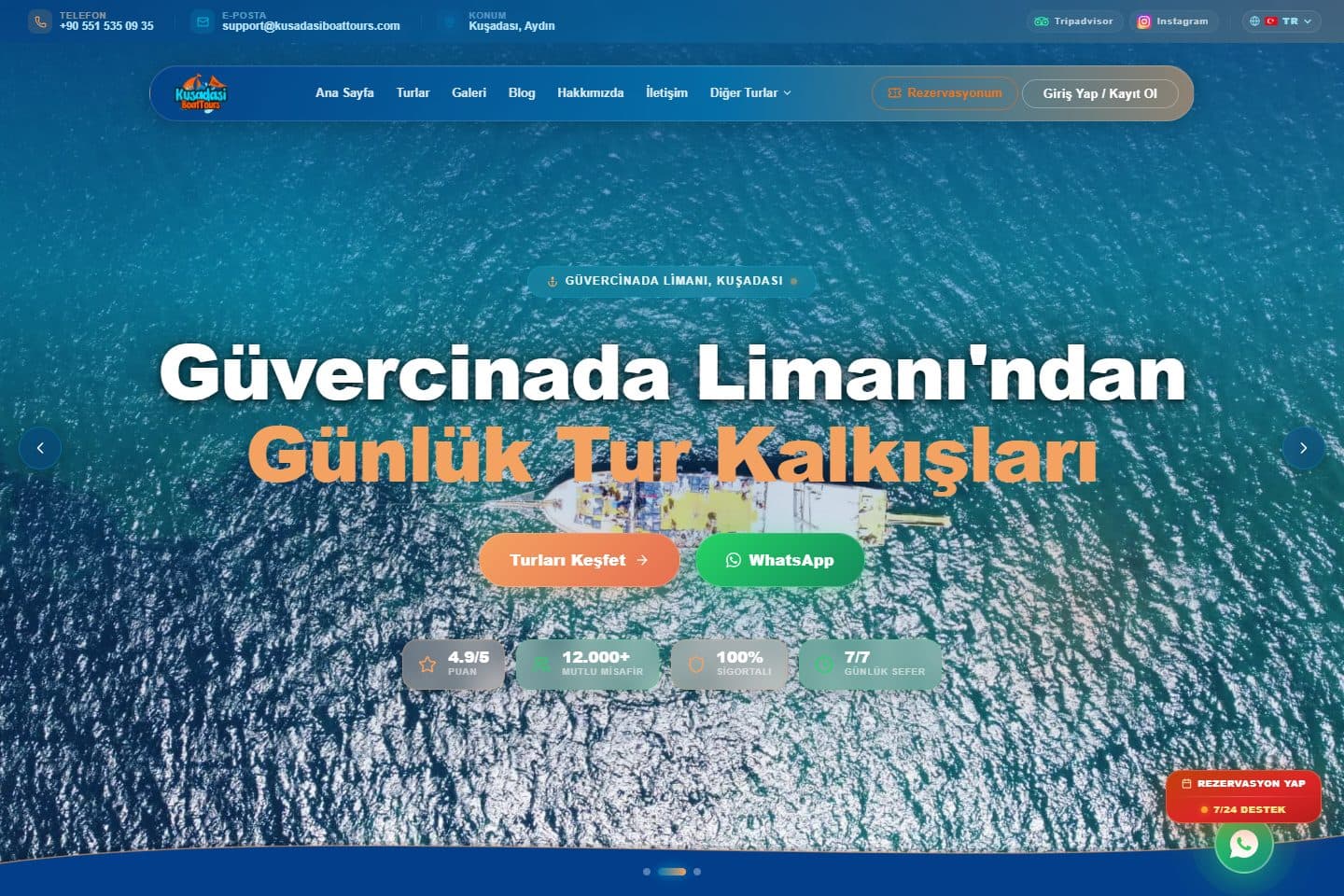
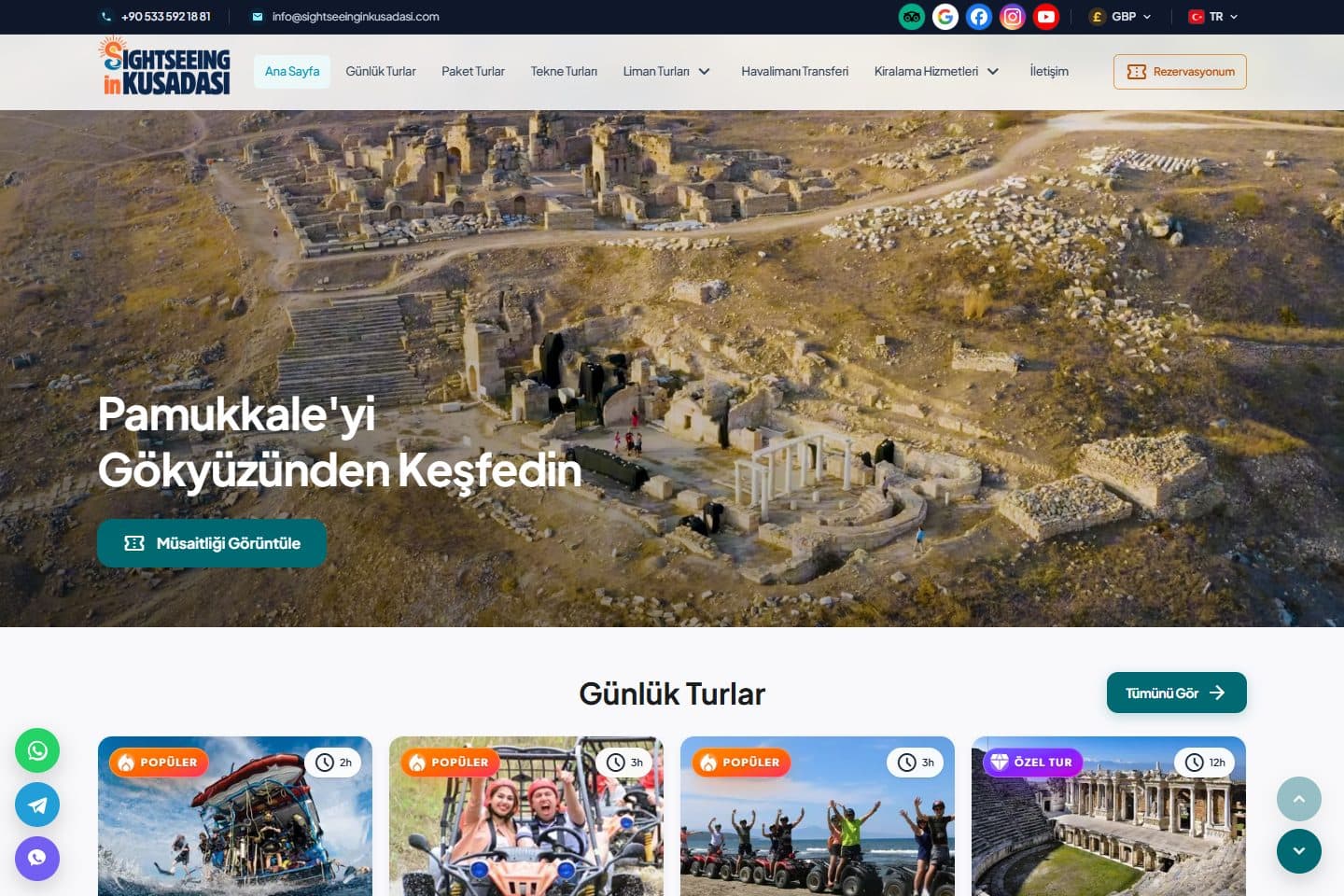
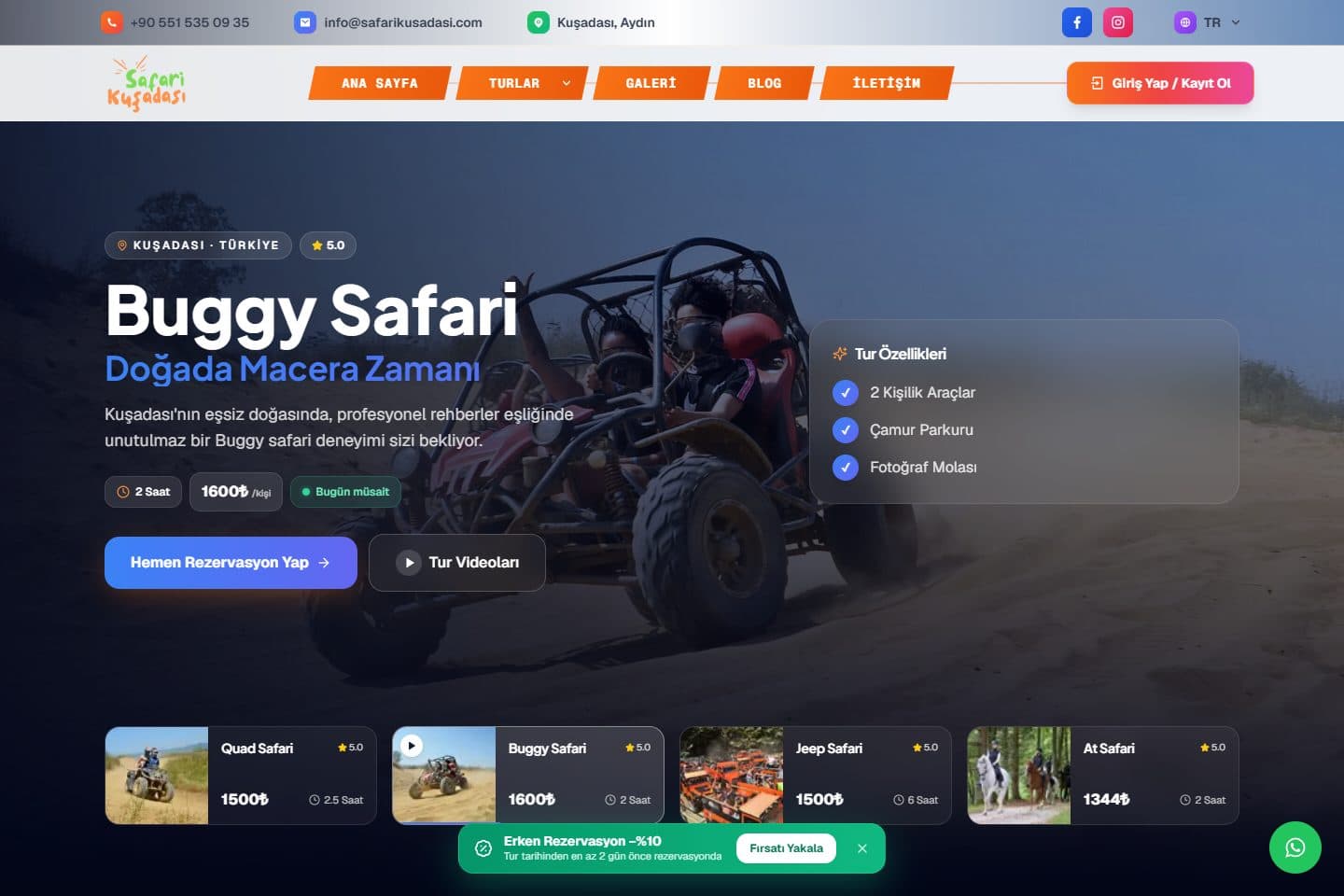
Building sites for tour and boat operators in Kuşadası, on Türkiye's Aegean coast, I've seen that what makes the difference is not the design but the operational questions: where do bookings land, how do prices update with the exchange rate, whose name is the site registered in. If these questions aren't asked at the proposal stage, you learn the answers mid-season, at the most expensive moment.
Below I've grouped those ten questions under seven headings. Whoever you hire — me or anyone else — ask these questions and insist on clear answers. The answers will make your decision for you.
If you sell to international guests, multiple languages are not decoration; they are the sale itself. The first question should be: will the languages be part of the site's structure, or an automatic translation layered on top of a single-language site? An auto-translate widget doesn't sell tours; guests who run into garbled sentences lose trust and leave without booking.
The second half of the question matters too: will you manage content in every language from a single panel? When you add a new tour, will you enter it separately for each language, or from one place? On my tour sites live in Kuşadası, every language is part of the structure; content is managed from a single panel and each language has its own page URL. That matters for Google as well — the search engine can list each language separately with its own page.
Discuss up front what adding a new language would involve. Your guest profile changes; if demand from a new market grows, will adding a language be a small job or a new project? This is something you'll want to know before signing the contract.
Ask: "What happens when the form is submitted?" In most proposals the answer ends with "it sends an email". An email from a late-night booking lands in spam, or gets lost among dozens of messages on the busiest day of the season. A booking needs to become a record: date, number of guests, tour, status — all in one place, searchable.
I saw this need in the field, not at a desk. In a business that tracks bookings between WhatsApp messages and a paper notebook, records get mixed up as the season picks up; who signed up for which day, was the deposit taken, how many people were there — it all comes down to memory. If there is a booking panel behind the site, that load is handed over to the site.
When collecting proposals, ask:
In Türkiye, tourism businesses typically price in euros or dollars while running their books in Turkish lira, and the classic headache is this: every time the rate moves, fixing prices page by page on the site. The job usually gets postponed, the site keeps selling at old prices for days, and the difference either comes out of your pocket or turns into an awkward negotiation with the guest.
The question to ask is clear: can the price be defined once in a foreign currency, with the site updating itself at the current exchange rate? On my tour sites in Kuşadası this module runs live; the price is defined once, and when the rate changes the site updates the prices itself. Manual price correction is no longer a task.
Let me add: not everyone needs this. If you fix your prices in lira and aren't affected by the exchange rate, this module isn't a priority for you. What matters is that you make the decision knowingly — that you don't sign a contract without hearing the answer to "is this possible?"
Two questions come together here. The first is about the off-season: what will the site do in the winter months? Is there a panel where you can add content, or will you have to go back to the developer for every article? A site that builds up content in the off-season is ready in search results when the season opens; a site that sits idle with the door locked starts from zero every season.
The second is about running accounts. A tour business doesn't work alone; there are agencies, boat owners, vehicle owners and guides, and money flows back and forth between you all season. Will these accounts be kept in the panel behind the site, or in a ledger completely separate from it? In the setup I built in Kuşadası, finance, accounting and supplier accounts sit in the same panel as bookings; at the end of the season, who is owed what is not up for argument.
Not everyone needs full integration either. Starting small and adding modules as the need arises is often healthier. Ask anyway — because "this setup can't do that" and "you don't need it now, it can be added later" are two very different answers, and you want to hear either one before signing.
Whose name is the domain registered in? If the answer isn't "yours", stop and think. The domain should be registered to the business; if you part ways with the developer, you shouldn't lose, along with the site, the address you've been giving your guests for years.
Watch out for the rented-site model, too: you pay monthly, the code and content stay with the developer, and when you stop paying the site goes down. If this model is stated clearly from the start it can be a conscious choice; if it's hidden between the lines of the contract, it's a problem. Ask openly: "If I want to work with someone else tomorrow, do the site, the content and the booking records come with me?" I wouldn't sign a proposal that couldn't give a clear answer to that question for my own business either.
Maintenance is as concrete an issue as ownership. Once the site is live, who will update it, who will step in if something breaks, will there be someone you can reach mid-season? If the question "who handles maintenance?" is left hanging, you have accepted from the start the risk of being left alone with a crashed site in August.
Tourism guests mostly reach your site from their phones — on hotel Wi-Fi, on a ferry, on a roaming connection. A site that looks sleek on desktop but loads slowly on a phone gets closed before the guest even sees a price. Ask at the proposal stage: is the site developed and tested on phones, and are images resized for mobile?
Google also evaluates a site primarily by its mobile version; a site that performs poorly on phones falls behind in search results too. Your own test is simple: open the developer's previous work on your own phone, on mobile data rather than Wi-Fi. If those are slow, your site will most likely be slow too.
Once the site is live, the next step is usually advertising; and advertising without measurement is budget spent in the dark. The question to ask: will phone taps, WhatsApp taps and form submissions be tracked? Will you be able to see how many booking requests come from which channel?
In the businesses whose ads I manage, I see that the most valuable data comes from the site itself: which tour page draws interest, at which step guests give up, whether they prefer calling or messaging. If tracking isn't set up from the start, it's hard to answer these questions later — past data can't be collected retroactively. When you take delivery of the site, ask for tracking to be delivered already set up; it's the foundation for every advertising decision you'll make afterwards.
The point of these ten questions isn't to steer you toward a particular proposal, but to make sure that whichever one you sign, you sign it with your eyes open. Some of the questions may turn out to be unimportant for your business; others you'll badly regret not asking before the contract. I learned most of these answers by working on tour sites that are live in Kuşadası; if you're curious about the kind of setup I build, you can look at those sites and the details of my tourism website service. Just ask — you'll work comfortably with anyone whose answers are clear.
As a shop window, yes; as an operational tool, no. A ready-made theme displays tour pages but doesn't handle booking records, exchange-rate pricing or supplier accounts. It may be enough for a small business that's just starting out; as booking volume grows, it's exactly these gaps that start to pinch.
As many as your guest profile requires. Every language is also a maintenance load; a half-finished language whose content isn't updated costs trust rather than building it. Rather than launching them all at once, it's healthier to start with as many as you can keep complete and add languages as the need arises.
Not necessarily. Ask your current site the questions in this article: do bookings become records, is the domain in your name, is it fast on phones? If most of the answers are good, keeping the site and adding the missing modules may make more sense. If most are bad, rebuilding costs less than patching the old one.
Platforms can remain a sales channel; your own site is your commission-free channel and your direct relationship with the guest. The healthy setup is the two working together: a guest who discovers you on a platform makes their next booking on your site. And on your own site, the guest's data and communication stay with you.
The guide speaks in general terms; your business is specific. Let's start with a message.